
Pike ICE Detention Transfers Aren't Releases
ICE detention is a federal civil immigration system. It is not the Pike County Sheriff's six-hour holding operation, an Ohio prison, or a Federal Bureau of Prisons institution. No official source reviewed through July 31, 2026 identified an ICE detention center inside Pike County. The network matters because a person can move from a local criminal hold into ICE custody, not because ordinary Pike detainees are routinely sent there.
That distinction changes the first question. Ask whether Pike released the person to the community or transferred the person to another custodian. A local release or transfer entry should name the destination agency when recorded. If the event involves an ICE detainer, meaning a request that immigration authorities be notified or assume custody, the end of the county hold does not mark freedom from all custody.
The Pike sheriff's Corrections Division explains that people may leave its short-term facility for another jail. Corrections at 740-947-2111 ext. 2 is the person-specific movement channel. Records at ext. 3 can provide the local release or transfer entry. The Pike County holding facility record path covers that local side of the handoff.
Search ICE Detention Network Records
The ICE Online Detainee Locator System, often shortened to ODLS, is the official public search for a person in covered ICE custody. ICE also says it may locate someone in Customs and Border Protection custody for more than 48 hours. The tool is current-custody oriented. It does not serve as a complete historical list of everyone once held or released by ICE.
- Confirm that an ICE transfer is supported by a Pike movement record, court information, or direct agency statement.
- Gather the person's exact name, country of birth, date of birth, and A-number when available.
- Search ODLS by the nine-digit A-number and country of birth. Add leading zeros when the number has fewer than nine digits.
- If the number is unknown, use the biographical search with exact identity details and careful spelling.
- Record the query date, search mode, spelling, and exact result. Do not shorten a no-result message to “released.”
- When a location is returned, contact that facility or ICE for current custody and release information.
A local current-inmate list answers only whether a person appears in that local list at the moment checked. ODLS answers a different question about covered immigration custody. Neither system alone establishes the full custody chain. The Pike movement record connects the local exit to the federal entry, while the federal source owns the later ICE status.
Note: Preserve exact names and identifiers because spelling, recent processing, and agency data timing can change the search result.
ICE Detention Locator Search Modes
ODLS offers two identity paths because immigration records often depend on an A-number, while family members or counsel may have only biographical facts. The modes are not broad county filters. Neither lets a user search “Pike County releases” or browse a reliable historical release archive.
| Search mode | Inputs | Important limit |
|---|---|---|
| A-number search | Nine-digit A-number and country of birth | Leading zeros may be needed; the number and country must match |
| Biographical search | Exact name, country of birth, and other fields shown | Compound, hyphenated, and alternate names require care |
Use the A-number route first when a reliable number is known. An A-number is the immigration file number, not a Pike booking number, ODRC offender number, or BOP register number. Do not move an identifier from one system into another field merely because both are numeric. If only a name is available, test accurate legal forms and documented aliases rather than guessing.
Minors are excluded from the public locator. ICE may also omit a person due to recent processing, safety, security, or other agency limits. These exclusions explain why even correct details may not return a public match. They do not establish where the person is or what event occurred.
ICE Detention No-Match Release Limits
An ODLS no-match is not a historical release record. It can reflect spelling, an incorrect country of birth, a missing leading zero, a recent transfer not yet shown, an excluded case, or custody in a different system. It may also mean ICE never took custody. Report the result as “no match using these fields on this date,” then continue the source check.
The official ICE detention resources describe locator limits and the Detention Reporting and Information Line. The captured agency page provides context for assistance and the boundaries of online search.
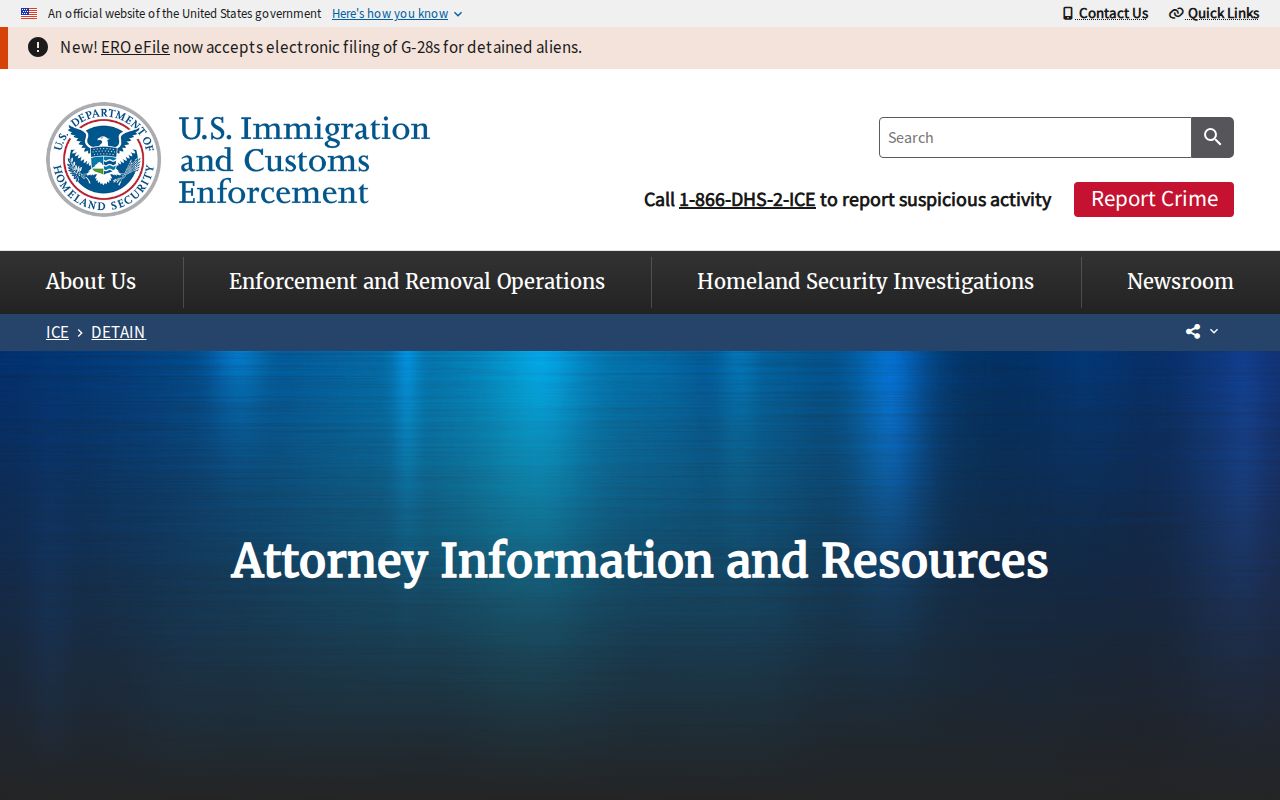
The image supports the federal fallback route. It should not be treated as evidence that a specific Pike County person entered or left ICE custody.
| Observed result | What it supports | What it does not prove |
|---|---|---|
| Current ICE facility returned | The federal system located covered current custody | The reason Pike's hold ended or a future release date |
| No ODLS match | No public match for the exact query at that time | Community release, discharge, or absence from all custody |
| Pike name disappears | The person is no longer displayed in that current local table | Release rather than transfer |
| Court order entered | A court authorized or recorded a legal action | The exact time another custodian carried it out |
Pike County-to-ICE Detention Path
Pike's unusual six-hour holding model makes the sequence central. A person may appear in the county's current table and then leave it quickly. That change can mean bond, a court-ordered release, transport to a contracted jail, commitment to ODRC, a federal handoff, or another movement. The web row contains too few fields to settle which event occurred.
For a suspected ICE handoff, begin with Corrections. Ask whether the person left all custody or moved, and request the destination. Next, check the correct Pike court docket for the criminal case, while remembering that a court entry does not prove physical transfer time. Sheriff Records can supply the local movement entry. Only then use ODLS and ICE contact routes to trace the federal side.
The evidence chain should remain separated: Pike current list → Pike Corrections movement answer → sheriff transfer record → ICE locator or assistance line → identified detention facility. Each source owns one part. If a court entry says a criminal hold ended but ICE shows current detention, describe both facts. Do not collapse them into “released.”
Note: No ICE facility physically located in Pike County was confirmed, so a federal result should identify its actual location.
ICE Detention Records and Contacts
The federal fallback is the ICE Detention Reporting and Information Line at 1-888-351-4024. Use it when ODLS does not settle a supported custody question, when location details need confirmation, or when the online search is unavailable. State the person's identifiers and explain the last verified point in the custody chain without assuming an unconfirmed Pike-to-ICE transfer.
ICE detention information
Online system: ICE Online Detainee Locator System
Information line: 1-888-351-4024
Scope: Covered ICE detention and federal detention assistance
Local limit: No Pike County ICE detention facility was confirmed
A facility returned by ODLS becomes the next record owner. Ask that facility or ICE to distinguish present detention, transfer, and completed release. The Pike sheriff cannot certify what occurred after federal custody began, just as ICE does not own Pike's earlier booking and movement log.
Historical or legal records may require a request to the federal agency that created them. The Pike public-records request route under Ohio law applies to Pike-held booking and transfer records, not federal ICE files. Keep the requests separate and identify the event each office owns.
ICE, BOP, and USMS Release Records
Federal custody is not one database. ICE handles civil immigration detention. The Federal Bureau of Prisons primarily tracks people in federal prison custody and provides a locator covering federal inmates from 1982 forward. The U.S. Marshals Service manages federal prisoners from arrest or court commitment through disposition or BOP transfer and often uses contract beds. USMS has no public nationwide historical locator like BOP.
- ICE ODLS
- Use when supported facts point to current civil immigration detention.
- BOP Inmate Locator
- Use for sentenced federal prison custody and covered federal release records.
- USMS and federal docket
- Use for federal pretrial custody, court status, and the actual contract detention path.
- Pike Sheriff
- Use for the county booking, short hold, and recorded local transfer destination.
The BOP Inmate Locator can show a release date or RELEASED location for covered records, but a no-match during federal pretrial detention does not prove release because the person may never have entered BOP custody. Likewise, USMS prisoner operations explain the federal pretrial and transfer role but do not provide a BOP-style public history search.
Ohio VINE and ODRC answer still other questions. VINE is a participating-agency status and notification layer. ODRC covers Ohio prison custody and state supervision. Neither replaces ODLS for supported ICE detention, and none turns a Pike current-list absence into a release record.
Note: Use the locator owned by the actual custodian; federal status terms should not be copied across unrelated systems.
Confirm ICE Detention Network Release
A completed ICE release needs an ICE-owned confirmation, not an inference from a blank locator result. Start with the last known detention facility or the federal information line. Ask whether the person remains detained, moved to another facility, or left ICE custody. Record the date, office, and exact response. A later court or legal process may require the underlying federal record rather than a telephone note.
Also check whether another custodian assumed control. Ending ICE detention does not rule out transfer to another authority, just as ending the Pike hold does not rule out ICE detention. For a person first seen in Pike County, retain the sheriff transfer entry and the federal response as separate parts of the chain. The Pike County released inmate search explains how to compare county, state, and federal sources without merging their status terms.
When records disagree, use the source that owns each event. Pike owns its physical release or transfer log. The court owns its order. ICE owns federal civil detention status. BOP owns federal imprisonment status. State conclusions narrowly, preserve query times, and avoid promising community release until the final custodian confirms it.