
Pike Holding Facility Release Paths
The Pike County Sheriff describes the Waverly operation as a six-hour hold facility. People may leave through bond, recognizance, a court-directed release, completion of a short credited term, or another lawful disposition. Many others are moved to a jail that contracts with the county. A felony sentence can instead lead toward Ohio Department of Rehabilitation and Correction reception. Federal or immigration custody is possible only when the underlying matter supports it.
Each path changes the next source. A community release remains documented by the sheriff’s movement entry and the court order. A contract-jail transfer shifts current custody verification to the receiving jail. Commitment to ODRC shifts the public correctional record to the statewide offender search. A local hold ending because a federal or ICE custodian assumes control is still a transfer, not release to the community.
| Movement | What it means | Next source |
|---|---|---|
| Bond or recognizance | Community release while the case continues | Sheriff release entry and Pike court docket |
| Contract-jail transfer | Continued county custody at another site | Corrections destination answer and receiving jail |
| ODRC commitment | State-prison custody begins | ODRC Offender Search and sentencing entry |
| Federal or ICE handoff | Another sovereign assumes custody | BOP, federal docket, USMS channel, or ICE ODLS as applicable |
| Sentence completion | The applicable credited term ends | Physical release entry and sentencing record |
The facility has no official public release archive. Its observed portal is a current-inmate table. A status conclusion must come from the movement channel that owns the event.
Why Pike Uses Six-Hour Holds
Pike’s six-hour design is the facility’s defining local feature. The official Corrections Division page says that after a detainee’s time there is up, the person is moved to jails contracted by Pike County. The sheriff does not publish a complete and current list of those receiving facilities. Therefore, a page for one assumed contract jail would misstate how the system works.
The receiving site is a person-and-date-specific fact. A sheriff news item may identify one jail in one case, but that does not establish a universal destination. Call Corrections, obtain the exact facility name, and then use that operator’s current roster or records office. This transfer-tracing task is more useful in Pike County than scrolling for a long local booking history that the web portal does not provide.
Pike's local release search is primarily a handoff search because the facility is built for short custody and transport.
Confirm Pike Holding Facility Releases
Begin with current display status, but do not stop there. The sheriff’s portal establishes only whether the person is shown in the current table at the time viewed. A removed row cannot identify a release type or receiving custodian.
- Open the sheriff’s current portal and note the date and time. Record only “listed” or “not listed” as observed.
- Call Corrections at 740-947-2111 ext. 2. Ask whether the person left all custody or was transferred.
- If transferred, obtain the receiving jail’s full name. Check that jail and ask its records office about any later movement.
- Search Pike County Court for county-level matters and Common Pleas for felony proceedings. Look for bond, sentence, commitment, or other controlling entries.
- Call Sheriff Records at ext. 3 for the retained booking and release or transfer entry.
- If the person entered state prison, switch to ODRC Offender Search. Use federal or ICE systems only when the case supports those custodians.
For a wider explanation of each custody type, the Pike County released inmate search maps the sheriff, courts, ODRC, VINE, BOP, and ICE channels. The facility-specific answer still begins with Corrections because only that unit can identify an individualized contract-jail destination.
Note: A court order establishes legal authority, while the sheriff or receiving jail confirms when the physical movement occurred.
Pike Holding Portal Has Limits
The observed Pike Confinement Manager response displays Last Name, First Name, Charges, and Bond. It has no visible historical person-search interface. No booking date, booking number, custody site, photograph, release date, release reason, destination, or archive was visible in the captured view. The page should therefore be read as a current display, not a release record.
The officially linked current-inmate portal provides the view of those limited columns captured July 31, 2026.
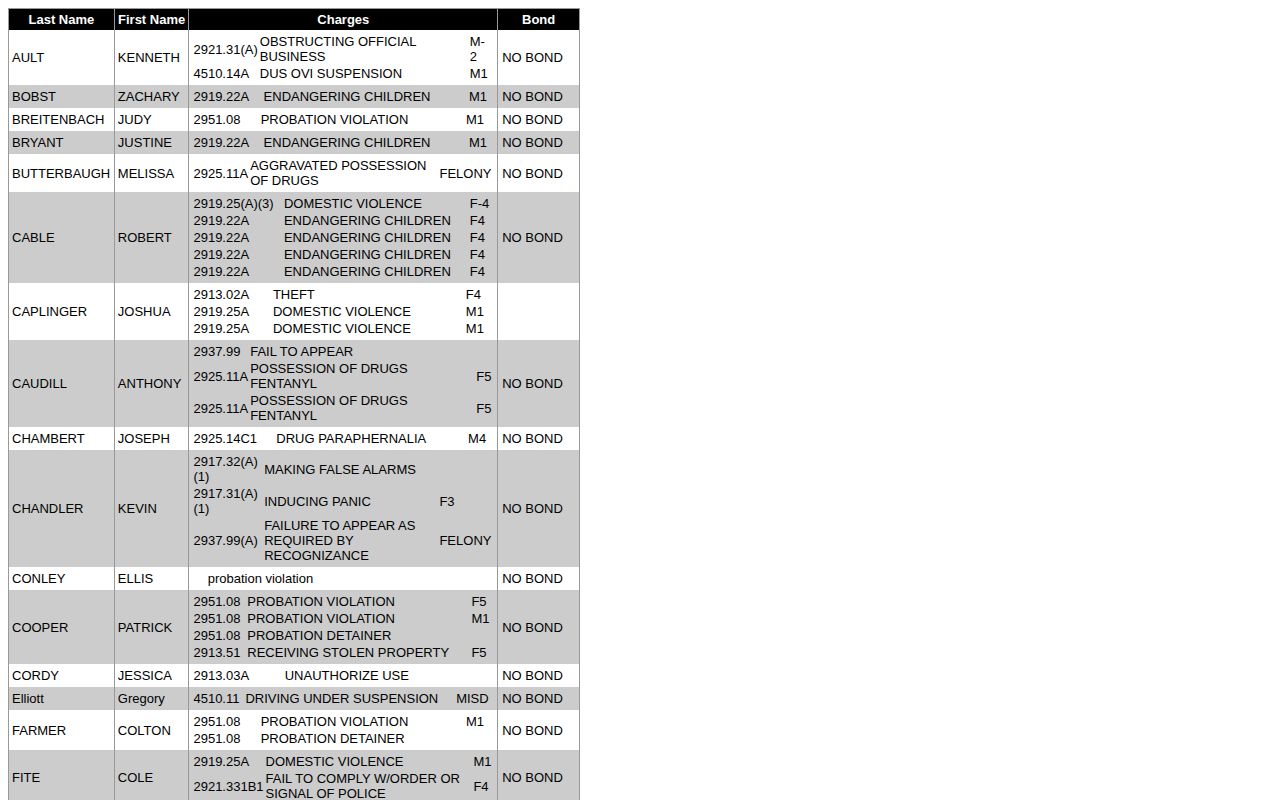
The image supports what was observed on the capture date. It does not prove that the portal will never change or that a missing person was released.
The sheriff also posted a system-change notice that broadly references a late-February through early-April period without naming the year. During an outage, the sheriff points callers to Corrections. The notice should not be turned into a claim about a present or permanent outage.
Pike Holding Release Records
A focused Sheriff Records request should identify the full name and approximate booking date. Ask for the booking or intake sheet, recorded release or movement date and time, recorded reason or disposition, receiving agency or facility if transferred, and booking photograph to the extent public. A case number can help distinguish namesakes.
No official Pike source reviewed through July 31, 2026 published a dedicated online release-record form, local copy fee, records email, guaranteed turnaround, or fixed booking-photo disclosure policy. Under Ohio Revised Code 149.43, public offices must prepare nonexempt records promptly for inspection and provide copies at cost within a reasonable period. Ask for a cost estimate before copies are made and request the legal basis for any withheld part.
14050 US Highway 23
Waverly, OH 45690
Main: 740-947-2111
Corrections: ext. 2
Records and record requests: ext. 3
Fax: 740-941-4068
Immediate location questions belong to Corrections. Documentary requests belong to Records. If the person was transferred, the receiving jail may own the later release entry.
Pike Holding Releases Need Court Context
Pike County Court CaseLook and Common Pleas eServices are separate systems. County Court covers its criminal and traffic docket. Common Pleas is the felony and general-division route. Search both when the charge level is uncertain. Relevant terms include bond, recognizance, dismissal, plea, sentence, jail-time credit, community control, judicial release, and commitment to ODRC.
The clerk warns that online judicial activity can take at least 24 hours, and sometimes substantially longer, to appear. A same-day release question cannot be settled by one web docket. Call or inspect the proper court record, then confirm execution with the custodian.
Does a bond order prove the person walked out? No. It identifies legal authority and terms. The sheriff or receiving jail’s physical movement entry establishes when custody at that site ended.
Note: Bond release means the case continues unless a separate court entry records dismissal, acquittal, or another final result.
Pike Holding Transfers Beyond County
A person sentenced to Ohio prison may disappear from local custody because ODRC received the person. Search the state system by name or offender number and use Pike as County of Commitment where helpful. That filter identifies a sentencing county, not a prison in Pike. An APA Supervision or Judicial Release status later can show physical release from prison under continuing authority.
Federal custody requires a different sequence. During pretrial detention, the U.S. Marshals Service may control the person while a local or contract jail supplies the bed. BOP may have no record yet. After BOP designation, its locator becomes the normal public route. Likewise, transfer from a local criminal hold to ICE is continued custody. ICE ODLS is relevant only when facts support that handoff, and a no-match does not prove release.
No federal or ICE detention facility physically located in Pike County was confirmed. Those routes are conditional, not routine descriptions of people leaving the holding facility.
Pike Holding Records Outlast Display
The sheriff posts no fixed online retention period because the portal is a present-custody table rather than an archive. A vanished row can coexist with retained sheriff and court records. R.C. 149.351 restricts unauthorized destruction and connects disposal to approved schedules. Court files follow separate court-retention rules.
Online visibility, agency retention, and access after sealing are different questions. Ohio sealing law measures eligibility from final discharge, which can come after physical release when supervision continues. Once a court order restricts access, use the proper clerk process and do not treat a missing index as proof the original event never happened.
The best facility record trail preserves the person’s identifier, observation time, Corrections answer, receiving jail, court case, and records-request result. These facts show the chain of custody without guessing from a missing web row.
Public Record Search
Sponsored Results