
Pike Projected Versus Actual Release
A projected date is a calculation or an eligibility marker. It is not a promise that a door will open at a set hour. Ohio Department of Rehabilitation and Correction records use the exact label Expected Release Date/Parole Eligibility Date. The slash matters. For a definite sentence, the field may reflect an expected end date. For an old-law, life, or parole-eligible sentence, it can mark when review may occur rather than when release will happen. Status, sentence structure, jail-time credit, parole results, and supervision dates give the field its meaning.
The actual release date records a completed event. An ODRC status of APA Supervision, paired with a supervision start date, can confirm that a person left prison under Adult Parole Authority oversight. A Released category may show a past state discharge, but the detail still needs review. For Pike County short-term custody, the sheriff operates a six-hour holding facility and often transfers people to contracted jails. Disappearance from Pike's current table can mean a move, not release.
Pretrial detention works differently. The person has not begun a final prison term, so there may be no sentence-based projected date to compute. Bond action, a recognizance order, dismissal, or another court decision may authorize release. The jail or receiving facility must then confirm that the order was carried out. Pike County release records and search paths explain how to trace that event after the name leaves a current list.
Find Pike Projected Release Dates
Start with custody type. ODRC's search is useful only for people in Ohio prison custody, under department supervision, or judicially released. It is not a county pretrial calculator. A Pike County sentence that remains in a local or contracted jail must be checked through the sentencing court and the jail that actually holds the person. The sheriff's Corrections Division says callers can learn where a detainee was moved.
- Identify whether the person is pretrial, serving a local jail term, in ODRC custody, or under parole review.
- For state custody, open the ODRC Offender Search. Use the offender number when known, or search by name and confirm Pike as the commitment county.
- Open the matching detail. Copy the complete Expected Release Date/Parole Eligibility Date label, status, sentence terms, jail-time credit, and observation date.
- For a local sentence, read the latest Pike County Court record or the Common Pleas felony docket. Then ask the current jail to verify its calculation.
- For a pending parole matter, compare the latest hearing result and any POA/PRD date with the later status and supervision start.
The court owns its sentencing order and jail-time-credit finding. ODRC owns its state sentence calculation. The local or contracted jail owns the physical movement record for a local term. If those sources differ, note the exact fields and retrieval times instead of merging them into one assumed date.
The official ODRC gateway shows the search context used for state records.
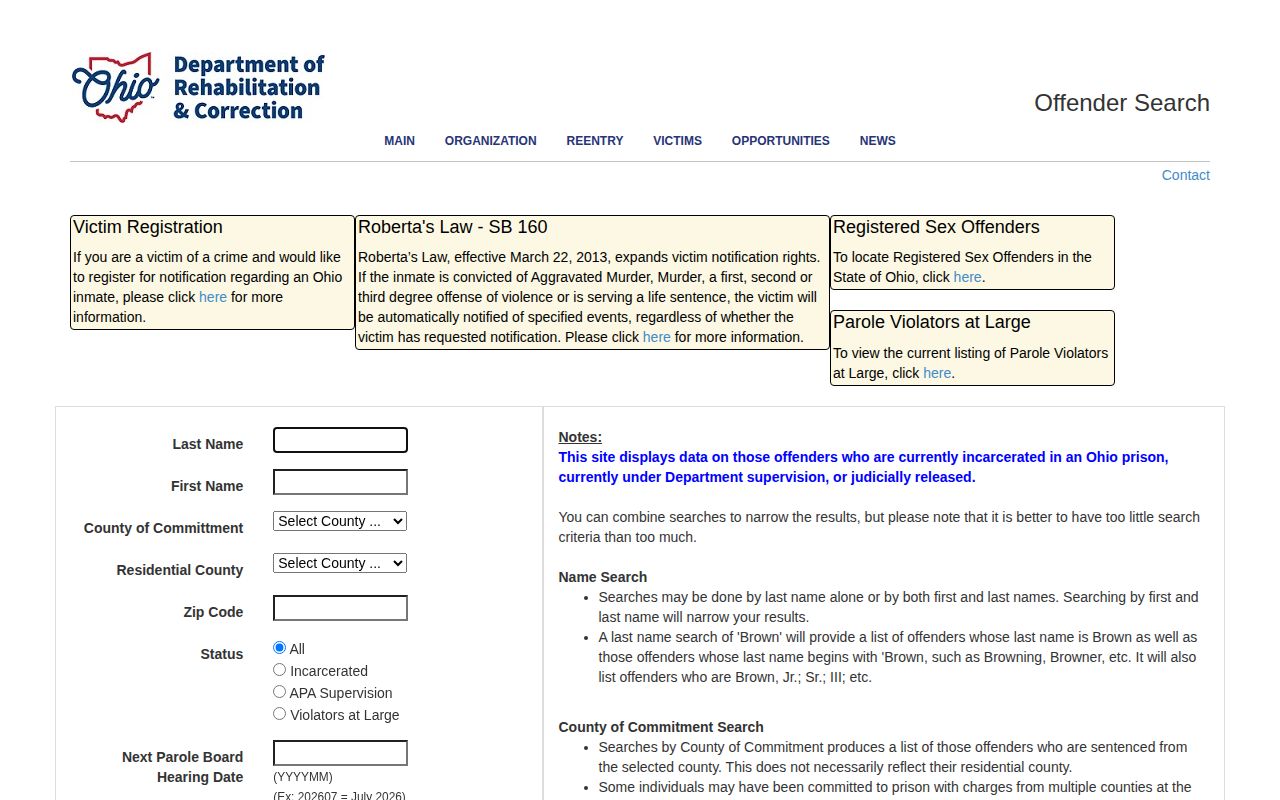
The captured gateway helps identify the correct statewide source, while an individual record supplies the date label and sentence context.
Note: County of Commitment identifies the sentencing county; it does not prove a person is held in Pike County.
Pike Release Date Record Fields
One date cannot be read alone. ODRC public details may display several fields that answer different questions. Some appear only when they apply, and the department warns that offense data can be incomplete. Match the person's birth data, offender number, docket, and commitment county before using any field. A begins-with surname search can also return namesakes.
| Field | What it can establish | Key limit |
|---|---|---|
| Status | Incarcerated, APA Supervision, Released, Judicial Release, or Violator at Large context | Status categories are not interchangeable release reasons |
| Expected Release Date/Parole Eligibility Date | An expected term end or a date pending parole consideration | It is not guaranteed physical release |
| Jail-Time Credit | Local confinement credited by the sentencing court | An amended court entry can change the calculation |
| POA/PRD | A parole-related on-or-after or projected date where shown | A Board action can be reviewed or rescinded |
| Supervision Start | The start of community supervision after prison release | Release from prison is not final discharge |
| APA Office | The supervising unit for an applicable record | It does not state an exact present location |
The definitions distinguish still more labels, including Earliest Possible Transfer Date, Expired Stated Term, and Expiration of Supervision Term. Transitional control or halfway-house placement may still involve correctional control. Keep these labels intact. Replacing all of them with “release date” erases the legal and custody difference the record is designed to show.
The documented ODRC public example displays expected or eligibility information beside parole results and supervision data.
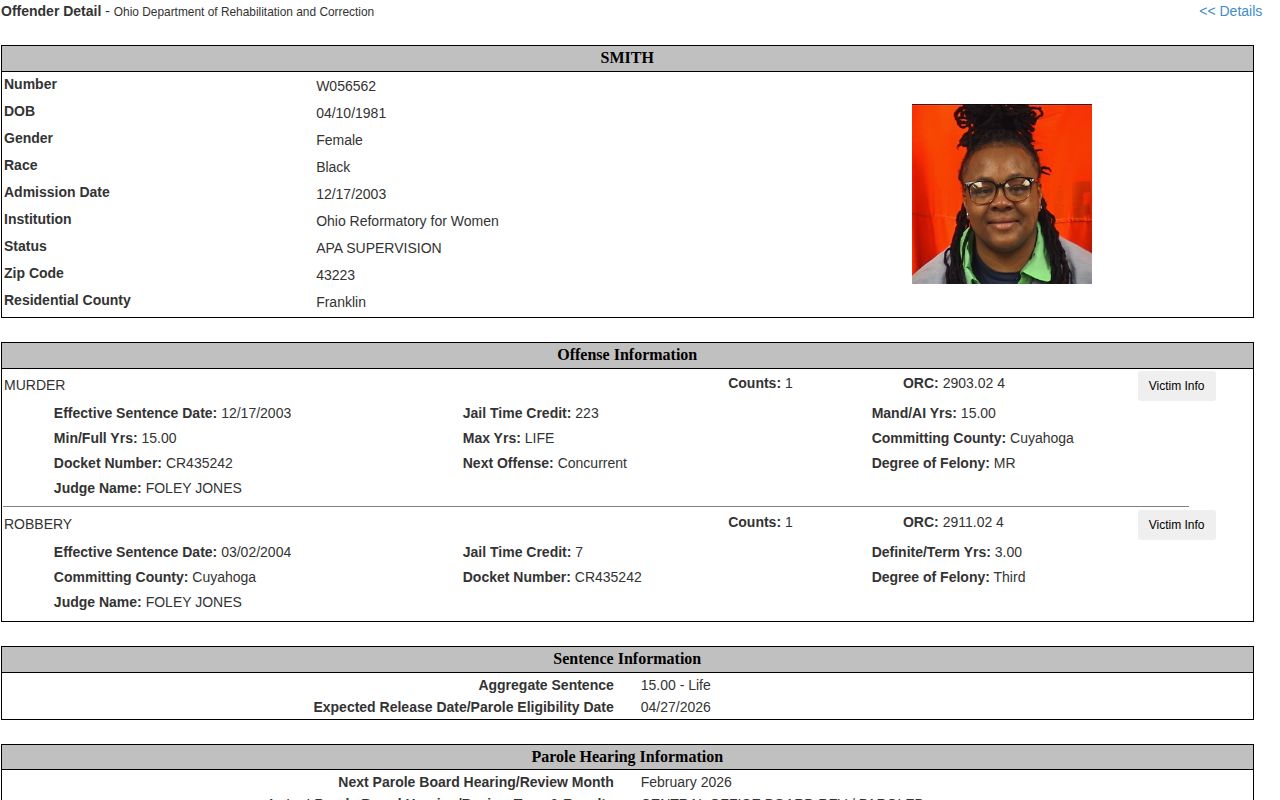
Its value is the relationship among the labels. It does not imply that every Pike County record has the same fields or outcome.
Pike Jail Credit Calculations
R.C. 2967.191 and O.A.C. 5120-2-04 govern jail-time credit in an Ohio prison calculation. The sentencing court identifies qualifying local confinement in its latest entry. ODRC then reduces the definite, minimum, maximum, or stated term by that court-awarded time and by other qualifying custody defined in the rules. Credit is not a free estimate based on the arrest date.
Sentence structure changes the math. Concurrent terms run at the same time and are diminished separately, with the longest remaining term generally controlling. Consecutive terms run one after another and are generally combined before the credit is applied to the aggregate. New counts, multiple dockets, or an amended credit entry can therefore shift the public expected date. If the dispute concerns the number of jail days awarded, the sentencing court must correct that figure. ODRC does not informally overrule the court.
A short Pike County jail term may never reach ODRC. In that case, check the local sentencing entry and call Pike Corrections at 740-947-2111 ext. 2 to identify the receiving jail. The current custodian calculates its release under the order it received. Records at ext. 3 can provide the local movement entry, while the court provides the legal basis for the term.
Pike Earned Credit Is Not 85%
Ohio has no universal rule that every person serves 85 percent. That Pike County release-date shortcut is inaccurate. Under R.C. 2967.193, an eligible incarcerated person may earn credit through qualifying productive participation and specified programs. The usual total cap is eight percent of the prison term. A limited transition rule permits some people who had already reached that cap by the statutory date to reach fifteen percent. Many sentences and offenses are excluded.
Those exclusions matter. Mandatory or nonreducible terms, death sentences, murder categories, life without parole, and specified sex-related sentences do not follow the ordinary earned-credit path described above. Program completion also does not make the public date final. Credits can be awarded, lost, or recalculated under the governing record.
A Risk Reduction Sentence is a different mechanism. For a qualifying sentence, O.A.C. 5120-2-14 can permit release after at least eighty percent of aggregate nonmandatory terms when the statutory sentence and program conditions are met. It is specialized, not the default. Modern Reagan Tokes indefinite terms also follow R.C. 2967.271, which creates a rebuttable presumption at the minimum or applicable earned date but allows continued confinement after required process, up to the maximum term.
Note: A parole eligibility date, earned-credit date, and Risk Reduction Sentence date arise from different legal paths.
Why Pike Release Dates Change
A future date is a snapshot. Several lawful events can move it earlier or later, and some change the meaning of the displayed field instead of just the number. Preserve a dated copy of the record. Then compare the next update with the court order, parole result, or correctional status that caused the change.
| Change | Effect on the date | Best source to check |
|---|---|---|
| Amended jail-time credit | Recalculates the remaining term | Latest sentencing entry and ODRC detail |
| Earned credit award or loss | May move an eligible projected date | ODRC calculation and public status |
| Concurrent or consecutive aggregation | Changes which term controls | Sentence entries and ODRC sentence fields |
| New sentence or violation return | Can add custody time or restart calculation | Court docket and ODRC status |
| Parole action | Can continue, set, review, or rescind a date | Parole result, POA/PRD, and later status |
| Judicial release or transitional control | May move the person from prison into controlled community placement | Court order and ODRC detail |
A detainer, meaning a request or hold from another authority, can also block community release even when one term ends. Pike's six-hour model makes transfer questions especially important. A county entry may close while another jail, ODRC, federal authority, or ICE continues custody. Ask who has the person now, not only whether one date passed.
Confirm Pike Actual Release Dates
Confirmation comes after the expected date. For ODRC, look for a status change and a supervision start or released record that fits the sentence. For a Pike County local term, call the actual jail and obtain the movement or release entry. A court order proves authority, but the custodian proves physical execution. If a date is needed for a formal court or legal process, request the source record rather than relying on a saved search screen.
ODRC Central Records handles state-record questions at P.O. Box 430, Columbus, Ohio 43216, and 614-752-1161. Pike Sheriff Records is reached through 740-947-2111 ext. 3. State notifications can add a timely alert, but they are not certified proof. The Pike County VINELink check describes how to register and how to confirm a reported change with the source agency.
- Projected date
- A calculated future date that may change.
- Eligibility date
- The first point when a person may be considered under the applicable rule.
- Actual release
- The completed physical exit or movement recorded by the custodian.
- Final discharge
- The end of all sentence components, which may occur after physical release.
Do not schedule travel or pickup from one future field. Confirm on the day through the jail, ODRC status, or supervising unit. Record the name of the office, the time, and the exact statement provided.