
Understanding Pike County Releases
A release record must answer four points: who moved, which custodian held the person, when the movement occurred, and why it occurred. In Pike County, the word “release” can describe bond, recognizance, completion of a sentence, dismissal, community control, parole, post-release control, or judicial release. It can also be used loosely for a transfer. That last use causes trouble. A person may leave the sheriff’s short-term operation and enter a contracted jail, an Ohio prison, federal custody, or ICE custody without spending a moment free in the community.
The owner of each record differs. The sheriff owns the local booking and movement entry. A court owns the order that set bond, imposed community control, dismissed a charge, or committed a person to prison. ODRC owns state custody and Adult Parole Authority supervision data. BOP and ICE maintain separate federal systems. “Discharge” usually means the sentence or supervision obligation has ended, while physical release may occur sooner. Those terms should not be merged.
- Time served
- A jail term ends after credited confinement satisfies it.
- Probation or community control
- A court supervises a person in the community instead of, or after, confinement.
- Parole
- The Parole Board permits release from an eligible prison term under APA supervision.
- Discharge
- The legal end of a sentence or supervision period, which may follow physical release.
Why Pike Releases Often Mean Transfer
Pike County’s key local fact is the sheriff’s six-hour holding model. The Pike County Sheriff Corrections Division says the Waverly operation is a six-hour hold facility. When that period ends, a detainee may be moved to a jail that contracts with the county. The sheriff does not publish a complete current list of those receiving jails. A single case report naming one destination does not establish where another person went.
That structure makes roster absence weak evidence. A name may disappear because bond was posted, but it may also disappear after a routine transport. The movement must be traced person by person. If Corrections identifies a receiving jail, use that jail’s current roster and records unit from then on. If staff confirms release to the community, request the local movement entry for the date, time, and recorded reason.
The Pike current-inmate table reviewed July 31, 2026 shows why its fields cannot establish a past release.
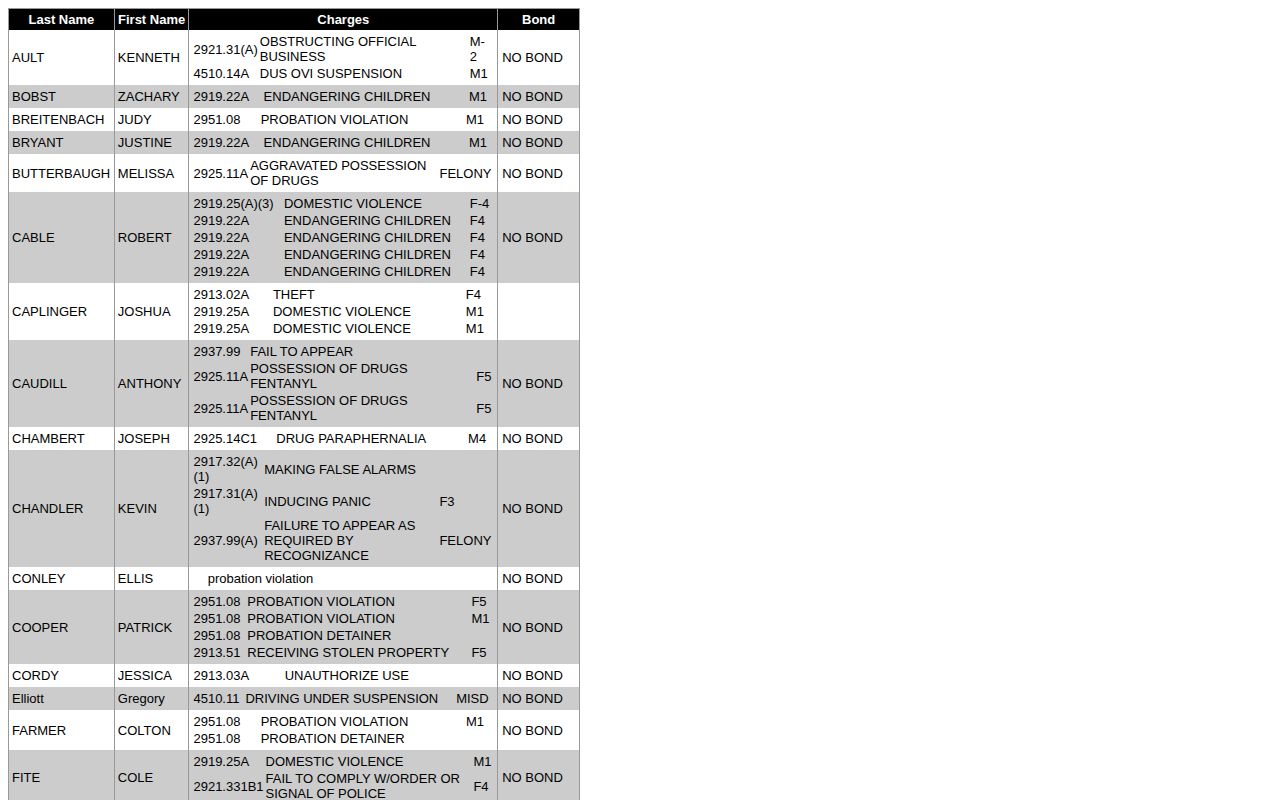
Its visible columns cover name, charges, and bond, not a release date, destination, or historical movement.
Pike County Release Types
The recorded disposition controls what the event means and where to look next. Bond release is not an acquittal. Parole is not final discharge. A transfer is continued custody. Matching the term to its next official record prevents a false conclusion.
| Outcome | Meaning | Next record |
|---|---|---|
| Bond or recognizance | Pretrial release under court terms; the case continues | Sheriff movement entry and court docket |
| Time served or sentence expiration | The credited local term ended | Release entry and sentencing record |
| Dismissal, acquittal, or no bill | The charge ended in the stated way | Court journal plus physical release entry |
| Probation or community control | The person remains under court authority in the community | County Court or Common Pleas docket |
| Parole, post-release control, or judicial release | Prison custody ended while state or court supervision continues | ODRC detail and court order |
| Contract-jail, ODRC, federal, or ICE transfer | Another custodian assumed control | Receiving agency locator or record |
Escape, an alleged supervision absconder, and death are also distinct events. None should be displayed as an ordinary lawful release. ODRC labels alleged supervision absconders as Violators at Large, often shortened to VAL.
Pike Bond Release Is Not Dismissal
The Pike County Court bond schedule sets local bond rules and offense-level amounts. It also adds $25 to surety, cash, and ten-percent bonds. The court's local rules address release after qualifying bail or bond while some domestic-violence or protection-order matters await a judge. These rules explain a lawful pretrial exit. They do not end the criminal case.
A bond entry should be paired with two facts. First, read the court order and any terms. Second, ask the custodian whether release was carried out. A docket can show what a judge authorized, while the sheriff or receiving jail records the physical movement. The two timestamps may differ.
The official bond page preserves the local distinctions used when Pike County release records show a bond-based exit.
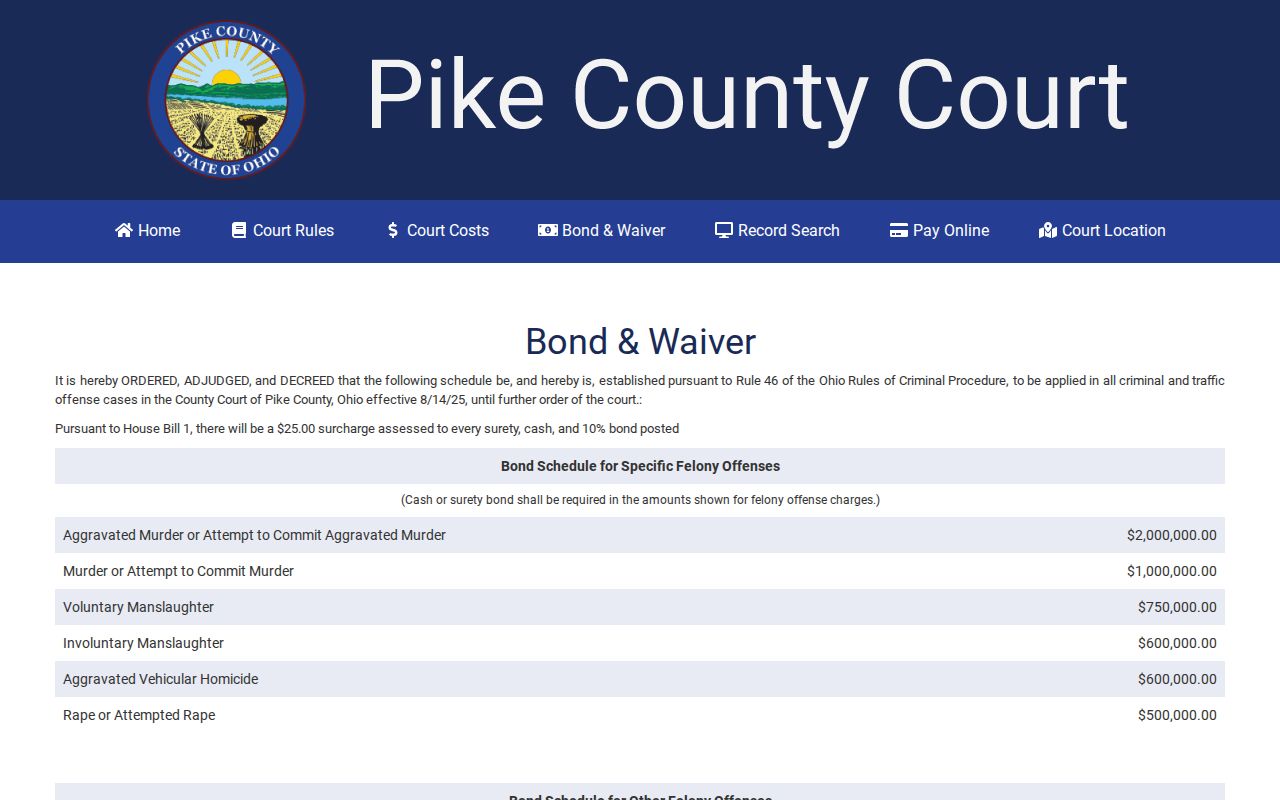
Read the applicable case entry as well, since the schedule alone does not show that a named person was released.
Pike County Release Record Fields
The public web table is not the full record. Sheriff Records can be asked for the booking or intake sheet and the entry that documents release or transfer. Fields may be split among the sheriff, court, receiving jail, and ODRC, so no portal should be expected to display every item.
| Field | What it shows |
|---|---|
| Full name and date of birth | Identity details used to avoid a namesake match |
| Booking or offender number | A persistent identifier for the custody event |
| Booking or admission date | When the custodian first received the person |
| Court and case number | The legal proceeding tied to the hold |
| Release or movement date and time | When that custodian’s control ended |
| Reason or disposition | Bond, sentence completion, court action, parole, or another stated basis |
| Destination or receiving agency | Whether custody continued elsewhere |
| Supervision destination | The court or APA office responsible after physical release |
Charge, sentence, jail-time credit, bond type, arresting agency, and a booking photograph may also be relevant. Availability depends on the record and lawful limits. A release entry supplies physical movement; a court entry supplies legal authority.
Request Pike County Release Records
Pike Sheriff Records is the local request channel. The agency publishes no dedicated online form, records email, local copy-fee schedule, fixed response time, or guaranteed photo-disclosure rule. Ohio law therefore supplies the request framework, while the office determines what responsive public records exist and what costs apply.
- Call Corrections at 740-947-2111 ext. 2 first if location is urgent. Ask whether the person was released or transferred.
- Contact Records at 740-947-2111 ext. 3. Give the full name, approximate booking date, and any known case number.
- Request the booking or intake sheet, movement date and time, recorded reason, transfer destination, and booking photograph to the extent public.
- Cite Ohio Revised Code 149.43, and ask staff to identify the legal basis for any withheld part.
- Ask for a cost estimate before copies are made. Do not assume a fee or deadline that Pike County has not posted.
14050 US Highway 23
Waverly, OH 45690
740-947-2111 ext. 3
Fax: 740-941-4068
A narrow request helps staff locate the right event. Ohio’s Public Records Act, within Revised Code Chapter 149, generally does not require a requester to state a purpose. If wording is too broad or unclear, the office should explain the issue and permit revision.
Pike Release Records and Final Discharge
Ohio records law separates retention, online display, and access after a court order. R.C. 149.351 restricts unauthorized destruction and connects disposal to approved schedules. A Pike roster row can vanish while sheriff or court records remain retained. Court records follow their own schedules, including special long-term rules for some Common Pleas conviction documents.
Sealing eligibility is measured from “final discharge,” which can occur after physical release because probation, community control, parole, or another sentence part may remain open. The current R.C. 2953.32 uses different waiting periods and exclusions based on the case. Pike County Court lists a $50 sealing or expungement filing charge effective December 1, 2025. That is a court filing cost, not a sheriff release-record fee.
Once relief limits access, use the clerk’s process and respect the order. A missing online case after sealing does not prove the custody event never occurred. Note: Final discharge and physical release are separate dates when supervision or another sentence component continues.
Find Pike County Released Inmates
Start with the last verified custodian, not a broad name search. Pike’s local list is useful only as a dated current-custody observation. From there, the sequence branches by transfer, court level, and sentence type.
- Check the sheriff’s current portal and record when it was viewed. Treat absence as unresolved.
- Call Corrections ext. 2 and ask whether the person left all custody or went to a receiving jail.
- Search Pike County Court for county-level matters and Common Pleas for felony proceedings. Confirm a time-sensitive entry with the correct clerk.
- Ask Sheriff Records ext. 3 or the receiving jail for the retained release or transfer entry.
- For an Ohio prison sentence, use ODRC Offender Search. For federal imprisonment, use BOP. Use ICE ODLS only when facts support immigration custody.
- Use VINELink for an added status or notification point, not as the certified source record.
Why did the name leave the roster? Pike’s current table tracks people shown in current local custody, not a released-person archive. A removed name may mean community release, transfer, or a portal update. Only the movement record identifies which event occurred.
For state supervision after prison release, the Pike County parole and probation resource explains APA status and local court probation.
Call Corrections for Pike Release Status
The person-specific transfer channel is unusually important in Pike County. The sheriff directs callers to Corrections at 740-947-2111 ext. 2 to learn where an inmate was moved. Ask a precise question: “Was this person released from custody or transferred?” If moved, record the receiving facility’s name and the date of the call before checking that jail.
Telephone information is best preserved as a dated note. Write down the unit contacted, the exact answer, and any destination supplied. Do not turn “moved to another jail” into “released.” During the sheriff’s broadly dated system-change notice, the same phone route is the stated fallback when the portal is unavailable.
Note: A six-hour holding limit describes facility operation, not the web portal’s update interval.
Two Courts Track Pike Releases
Pike County uses separate public court systems. County Court CaseLook covers its criminal and traffic docket. The Clerk's Common Pleas overview leads to Common Pleas eServices for felony and general-division proceedings. Search both when the charge level or path is unclear. Useful entries include bond, recognizance, dismissal, sentence, jail-time credit, community control, judicial release, sentence satisfaction, warrant, and commitment to ODRC.
The clerk warns that online judicial activity may take at least 24 hours, and sometimes much longer, to appear. A same-day question therefore calls for the custodian plus the correct clerk. An order can authorize release without proving the precise time the person left.
The official CaseLook capture shows the county-level route and its posting limits.
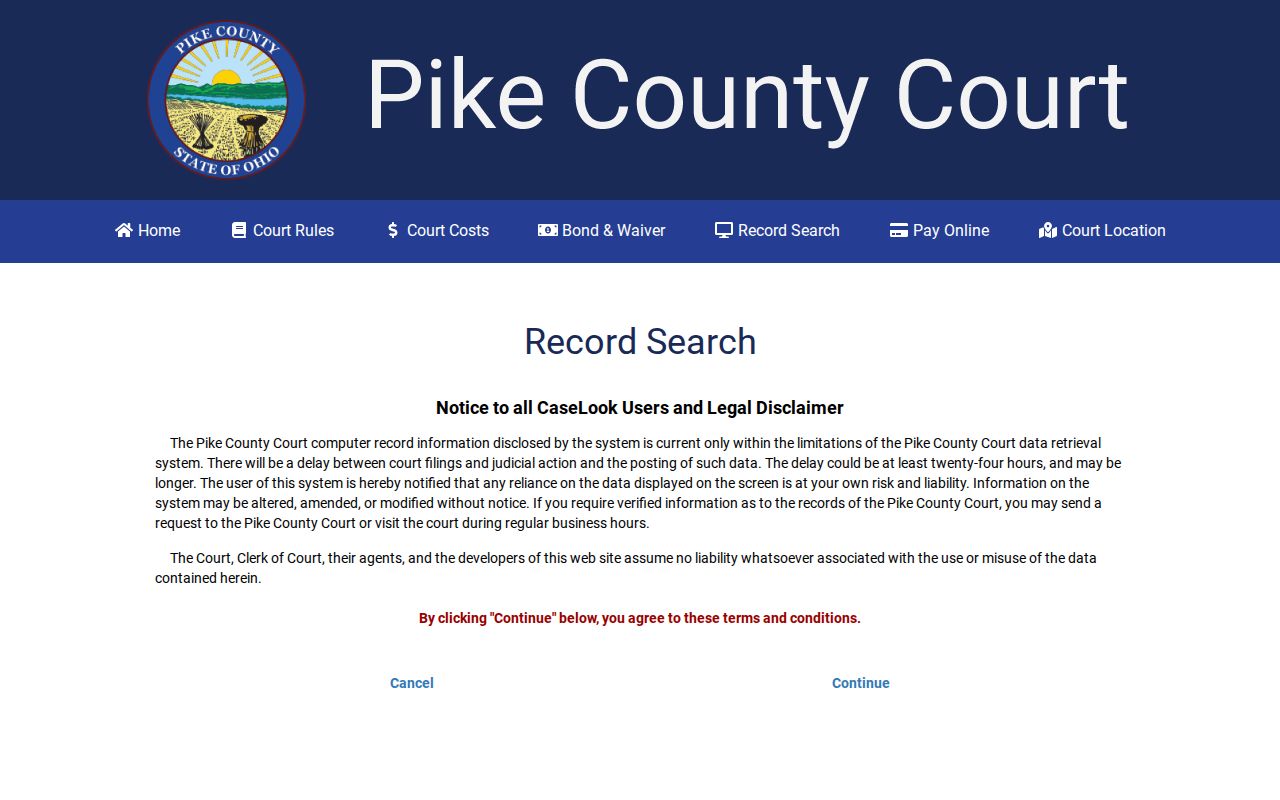
For a felony matter, switch to Common Pleas rather than treating the county-level search as complete.
ODRC Pike Release Status Search
The ODRC Offender Search covers people currently incarcerated in Ohio prisons, under Department supervision, or judicially released. It does not cover an ordinary Pike pretrial bond release or misdemeanor probation. Search by offender number when known. Ohio offender numbers use an A, R, or W prefix followed by six digits.
| Search field | Use and limit |
|---|---|
| Last and first name | Start broad; last name works as a begins-with search |
| Offender number | Best persistent match when the full identifier is known |
| County of Commitment | Choose Pike for the sentencing county, not current location |
| Residential County or ZIP | Last recorded APA or VAL information, not live whereabouts |
| Status | Incarcerated, Released, APA Supervision, Violators at Large, or judicial-release handling |
| Next hearing date | Enter a month as YYYYMM for the public parole schedule function |
Open the record and compare status, committing county, sentence, Expected Release Date/Parole Eligibility Date, Supervision Start Date, APA office, and latest parole result. The slash label matters. It can be an expected end date in one case and an eligibility date in another.
The documented ODRC Pike example shows how APA supervision, release-related labels, and a supervision start can appear together.
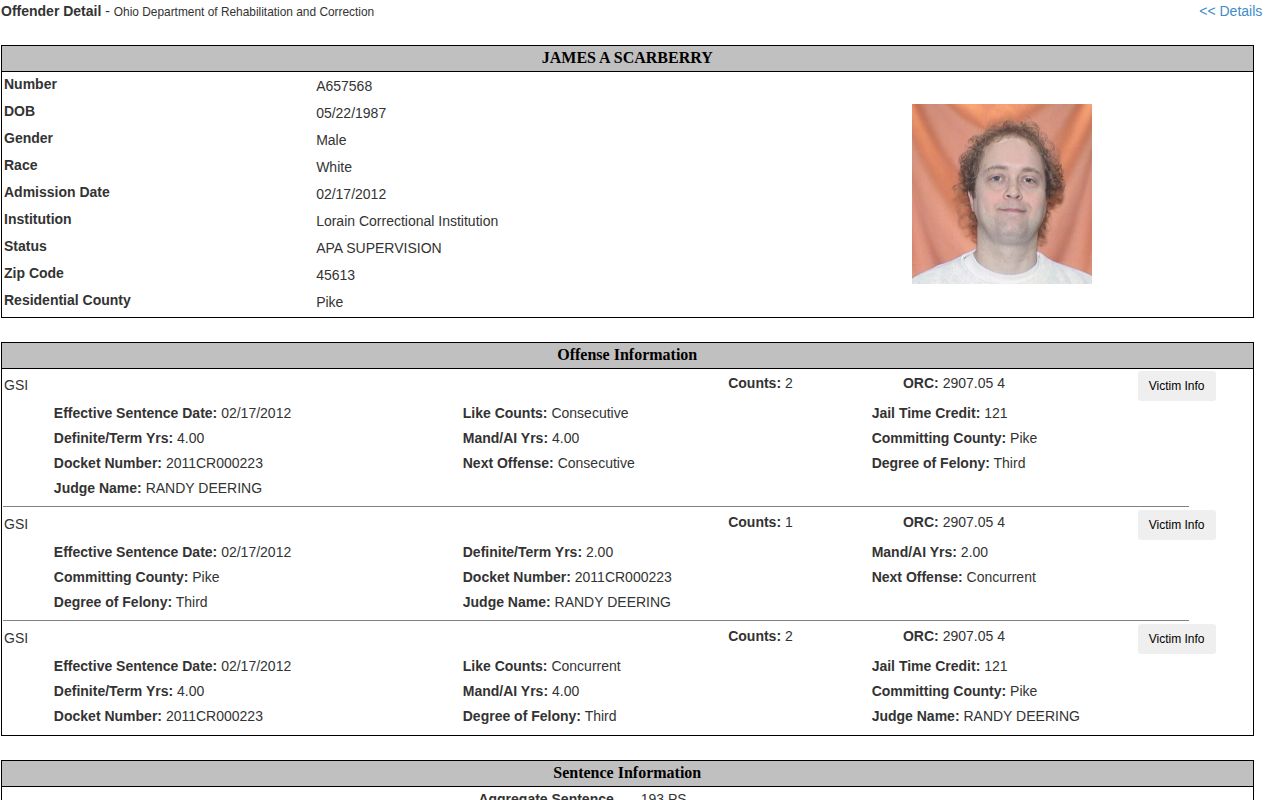
It demonstrates field relationships, not a promise that every public ODRC detail has the same fields.
Pike Release Alerts and Federal Custody
Ohio VINE is a custody-information and notification layer that works with sheriffs and ODRC. Search Ohio in VINELink, match the person by name or identifier, and preserve the source agency’s exact status wording. Phone, email, SMS, and TTY methods are described by the Ohio Attorney General. A release or out-of-custody result means a participating source sent a status change. It does not prove the reason, and the Attorney General warns against relying on VINE alone.
Federal systems are separate. The BOP Inmate Locator covers federal inmates from 1982 forward and can show a release date or RELEASED location. During federal pretrial custody, a person may instead be under U.S. Marshals authority at a contract jail and may never appear in BOP. ICE’s Online Detainee Locator is current-custody oriented. A no-match does not establish community release.
Pike County has no confirmed physical ICE detention facility. An ICE transfer should be discussed only when case facts support it. Movement from a criminal hold to ICE is continued custody.
Pike Release Records by Custodian
Each channel answers only the question its agency owns. Compare the system’s scope before treating a result as proof.
| Situation | Right source | What it proves |
|---|---|---|
| Currently shown in Pike’s table | Sheriff current portal | Displayed in current local custody at the observation time |
| Gone from Pike’s table | Corrections and Sheriff Records | Release versus transfer, destination, and movement entry |
| State prison or APA supervision | ODRC Offender Search | State status, dates, institution or supervision unit |
| Local court supervision | County Court or Common Pleas | Probation or community-control order and later case action |
| Federal imprisonment | BOP locator | BOP status and displayed release date |
| Supported ICE custody | ICE ODLS | A covered current detention result, not a full history |
When sources disagree, preserve each timestamp. The court owns the order. The jail owns physical release. ODRC owns state custody and supervision. Namesakes should be resolved with a birth date, middle name, case number, booking number, or offender number before records are joined.
Pike County Release Facilities
Pike’s facility map includes the local short hold and the state, federal, and immigration systems that may later own custody. The contracted receiving jail is not listed as a fixed page because the sheriff does not publish one complete, current roster of contract partners.
- Pike County Sheriff’s Office six-hour holding facility: call Corrections to distinguish local release from movement to a contracted jail.
- Ohio Department of Rehabilitation and Correction institutions: state status and later APA supervision appear through ODRC.
- Federal Bureau of Prisons institutions: sentenced federal custody and displayed release dates use BOP.
- ICE detention network: use ODLS only when immigration custody is supported by the facts.
The correct receiving facility may change by person and date. Confirm the actual handoff before using another jail’s roster or records process. Note: No federal or ICE detention facility physically located in Pike County was confirmed by the research.
Public Record Search
Sponsored Results