
ODRC Pike Release and Discharge
A person who leaves Pike County’s short-term holding operation for ODRC has been transferred or committed to state custody, not released to the community. The institution shown on the state detail becomes the relevant custody location. Later, the record may show APA Supervision, Judicial Release, a Released category, parole information, and dates tied to the sentence and supervision.
Physical release from prison does not always equal final discharge. APA Supervision means the person is outside prison under Department authority. Judicial release reflects a court-directed path to community control. Parole involves a Board decision for an eligible sentence. A past Released result may require detail review to understand whether supervision followed and when the sentence fully ended.
| ODRC status or field | What it can establish |
|---|---|
| Incarcerated | The person remains in an Ohio prison shown by ODRC |
| APA Supervision | Prison release occurred and state supervision is active |
| Judicial Release | A sentencing court used the judicial-release process |
| Released | A past ODRC release category that needs detail context |
| Violator at Large | Alleged absconding from APA authority, not lawful discharge |
| Expected Release Date/Parole Eligibility Date | A projected end or eligibility concept, not guaranteed physical exit |
The state record should be paired with the Pike sentencing entry when the legal basis matters. ODRC owns state custody and supervision data; the court owns the sentence and later journal orders.
ODRC Is a Statewide System
The Ohio Department of Rehabilitation and Correction operates institutions statewide. The facility entry represents that whole system because the particular prison is identified on an individual offender detail. Pike County is not the site of a generic ODRC prison. County of Commitment is a search filter tied to sentencing, while Residential County is a separate supervision-related field.
That distinction changes release research. The Pike sheriff cannot certify a later prison release date after state commitment. ODRC Offender Search and Central Records are the correctional sources. The Pike Common Pleas case remains useful for sentencing, jail-time credit, judicial release, or amended court orders.
No one statewide “facility address” applies to every ODRC record. Read the individual detail for the institution during incarceration and the APA office after physical release to state supervision.
Confirm ODRC Pike Release Status
The public search works best with an offender number. Ohio identifiers use an A, R, or W prefix followed by six digits. If that number is unknown, begin with a broad name query and add fields only as needed. ODRC itself advises using fewer criteria when a narrow search returns no match.
- Open ODRC Offender Search and enter the offender number, or begin with last and first name.
- Use Pike under County of Commitment to find people sentenced there. Do not treat the filter as present location.
- Select Incarcerated, APA Supervision, Released, Violators at Large, or judicial-release handling according to the question.
- Open the matching detail and confirm birth data, offender number, Pike commitment, docket, and sentence before joining records.
- Read Status with the Expected Release Date/Parole Eligibility Date, Supervision Start Date, APA Office, and latest parole result.
- Ask Central Records for a public release or discharge confirmation when the displayed fields are unclear or incomplete.
The official ODRC gateway displays the statewide fields used for Pike commitment and supervision research.
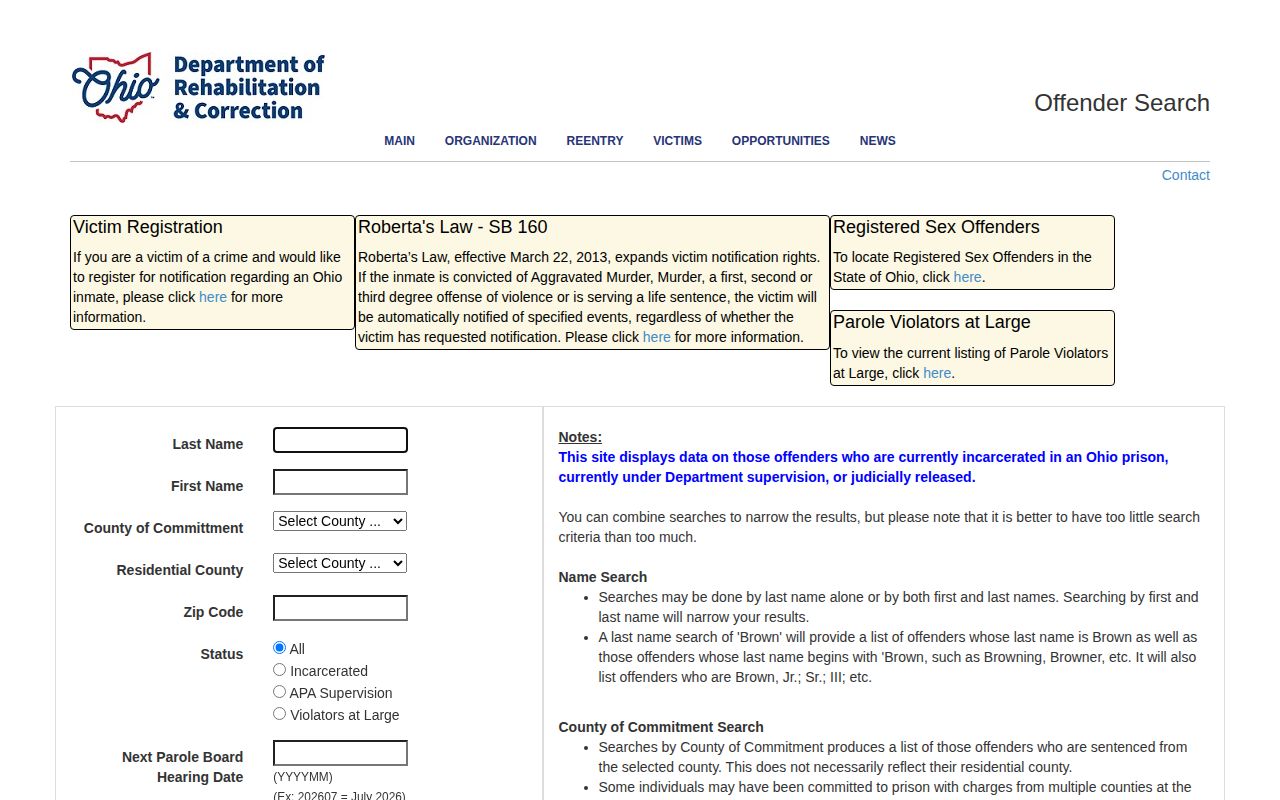
The gateway can find state prisoners and supervised people, but it is not the search for ordinary Pike bond releases or county probation.
ODRC Pike Search Fields Explained
The search provides Last Name, First Name, County of Commitment, Residential County, ZIP, Status, Next Parole Board Hearing Date, and offender number. Last name works as a begins-with search. Hearing month uses YYYYMM format and produces a public monthly schedule rather than a precise hearing-room appointment.
| Field | Pike-specific use | Limit |
|---|---|---|
| County of Commitment | Choose Pike for a sentence from that county | Multiple counties may be handled by the interface’s first-county logic |
| Residential County | Can narrow APA or VAL records to Pike | Last recorded data, not guaranteed current residence |
| Status | Separates prison, supervision, released, and VAL categories | A label still needs the individual detail |
| Offender number | Best exact correctional identifier | Requires the proper prefix and six digits |
| Hearing month | Builds the monthly Parole Board schedule | Not a day, time, or location calendar |
Residential County and ZIP describe the last recorded information for certain supervision searches. They must not be repeated as a person’s real-time whereabouts. County of Commitment likewise does not prove current residence or current prison location.
Note: Search results should be saved with the retrieval date because status, office, and release-related fields can change.
Read ODRC Release Record Fields
An individual detail can include name, offender number, birth date, admission date, institution, status, photograph, offense and sentence data, jail-time credit, committing county, docket, Expected Release Date/Parole Eligibility Date, hearing month, parole result, POA/PRD date, supervision start, supervision period, APA office, and conditions. Field availability varies by sentence and status.
The slash in Expected Release Date/Parole Eligibility Date must be preserved. For a definite term, the value may work as an expected end date. For an old-law, life, or parole-eligible structure, it can identify eligibility or consideration instead. It is not a guaranteed pickup time. Read it beside status and actual supervision start.
The documented ODRC public example tied to Pike fields shows APA supervision, the combined expected or eligibility label, and supervision start.
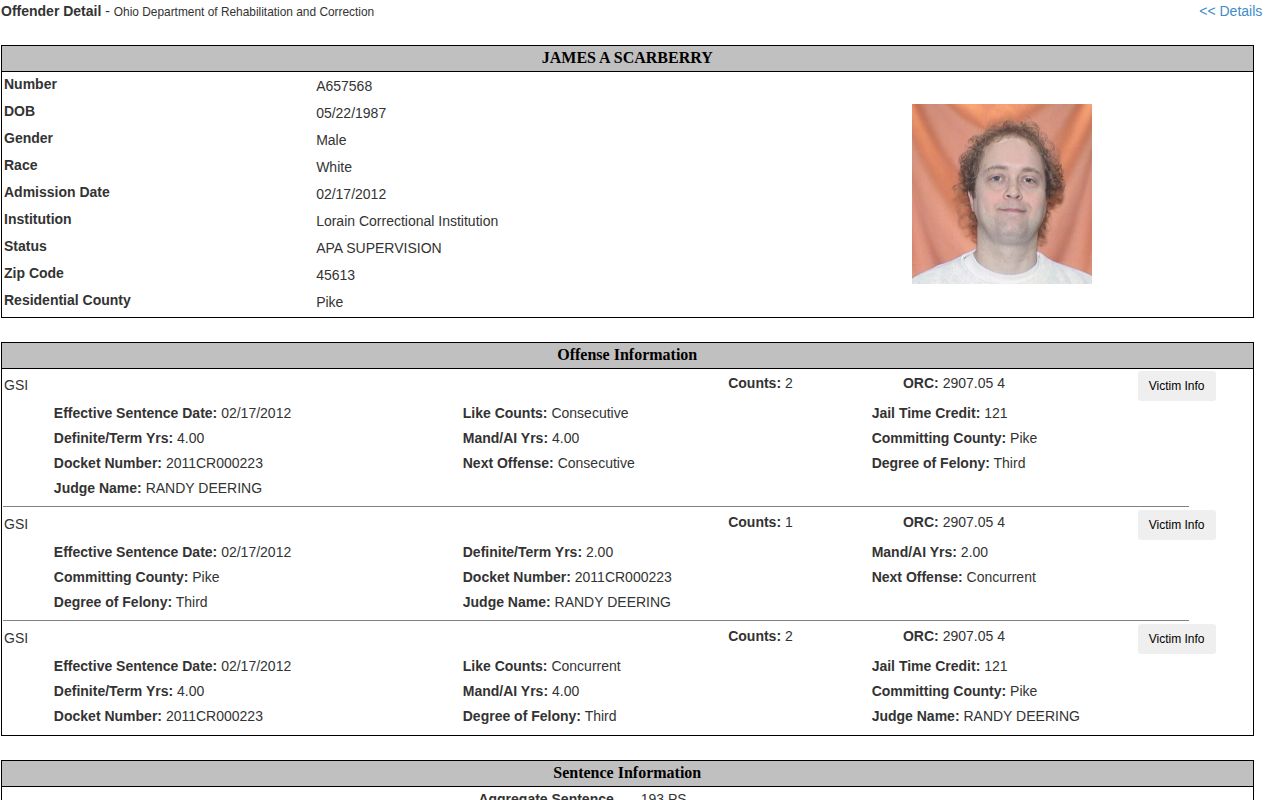
The example demonstrates how fields relate. It should not be used to claim that every ODRC record displays the same information.
ODRC Pike APA and Parole
The Adult Parole Authority manages state post-prison supervision. The Ohio Parole Board carries release-authority functions for applicable sentences. Parole, post-release control, and judicial release are not synonyms. The public detail is the safest place to identify which mechanism applies to one person.
APA Supervision is affirmative evidence that the person was physically released from prison into Department supervision. It is not final discharge. The Supervision Start Date can help confirm when that transition occurred. The APA Office field identifies the supervising unit, while the displayed conditions and period provide public context.
For parole cases, the individual detail may show Latest Parole Board Hearing/Review Type & Results and a Parole On or After or projected-release field. A grant can be reviewed or rescinded before physical release. Status changing to APA Supervision, together with a supervision start, is stronger evidence of actual release than a Board result alone.
More on these distinctions appears in the Pike County parole and probation record. That page also separates state APA supervision from probation imposed by Pike County Court or Common Pleas.
ODRC Release Records and Contact
ODRC Central Records is the contact when the public detail does not fully answer a release or discharge question. Ask for the public confirmation and identify the person by full name, offender number, Pike commitment, and approximate dates. Do not request a vague complete file when a specific status or date will answer the question.
R.C. 5120.21 requires an internal commitment and discharge record but restricts much of the inmate file. The same section expressly does not bar disclosure of categories including name, conviction, photograph, and current or past incarceration or supervision status. Lawful redaction or denial can therefore accompany a focused request.
Attn: Central Records
P.O. Box 430
Columbus, OH 43216
614-752-1161
Parole Board determinations, orders, and required-hearing minutes are public records under O.A.C. 5120-9-49. Request those minutes when a summary result does not supply enough context.
Pike Jail and ODRC Differ
Pike’s current local list covers people shown at the sheriff’s short-term operation. It does not supply a past ODRC discharge record. Conversely, ODRC does not track an ordinary county pretrial bond release, a short local sentence that never reached state prison, or misdemeanor probation imposed by Pike County Court.
| Question | Record owner |
|---|---|
| Was the person released or transferred from Pike’s six-hour hold? | Pike Corrections and Sheriff Records |
| What did the Pike court order? | County Court or Common Pleas Clerk |
| Did the person enter an Ohio prison? | ODRC status and institution fields |
| Was the state prisoner released to APA supervision? | ODRC status, start date, and APA office |
| Did local probation end? | The supervising Pike court |
When records conflict, keep each system’s exact wording and retrieval time. A court order does not supply the prison gate time, and a correctional projected date does not replace the court’s sentence.
ODRC Discharge and Record Limits
Final discharge can occur after physical prison release because APA supervision or another sentence component continues. That distinction also matters in Ohio sealing analysis, which can measure waiting time from final discharge rather than the prison exit. Use the individual record and court order instead of calculating a discharge date from a projected field.
ODRC warns that offense information may be incomplete and that a displayed supervision period can reflect an earlier offense. A public screen is a useful correctional status source, not the entire internal file. For legal precision, obtain the court journal entry and a focused public response from Central Records.
The Pike County released inmates search explains how the state path fits beside the sheriff, local courts, VINE, and federal systems. Start with the custodian that owned the event and avoid merging dates silently.
Note: A Released search category, APA Supervision, and final discharge answer three different questions.
Public Record Search
Sponsored Results